Table Of Content
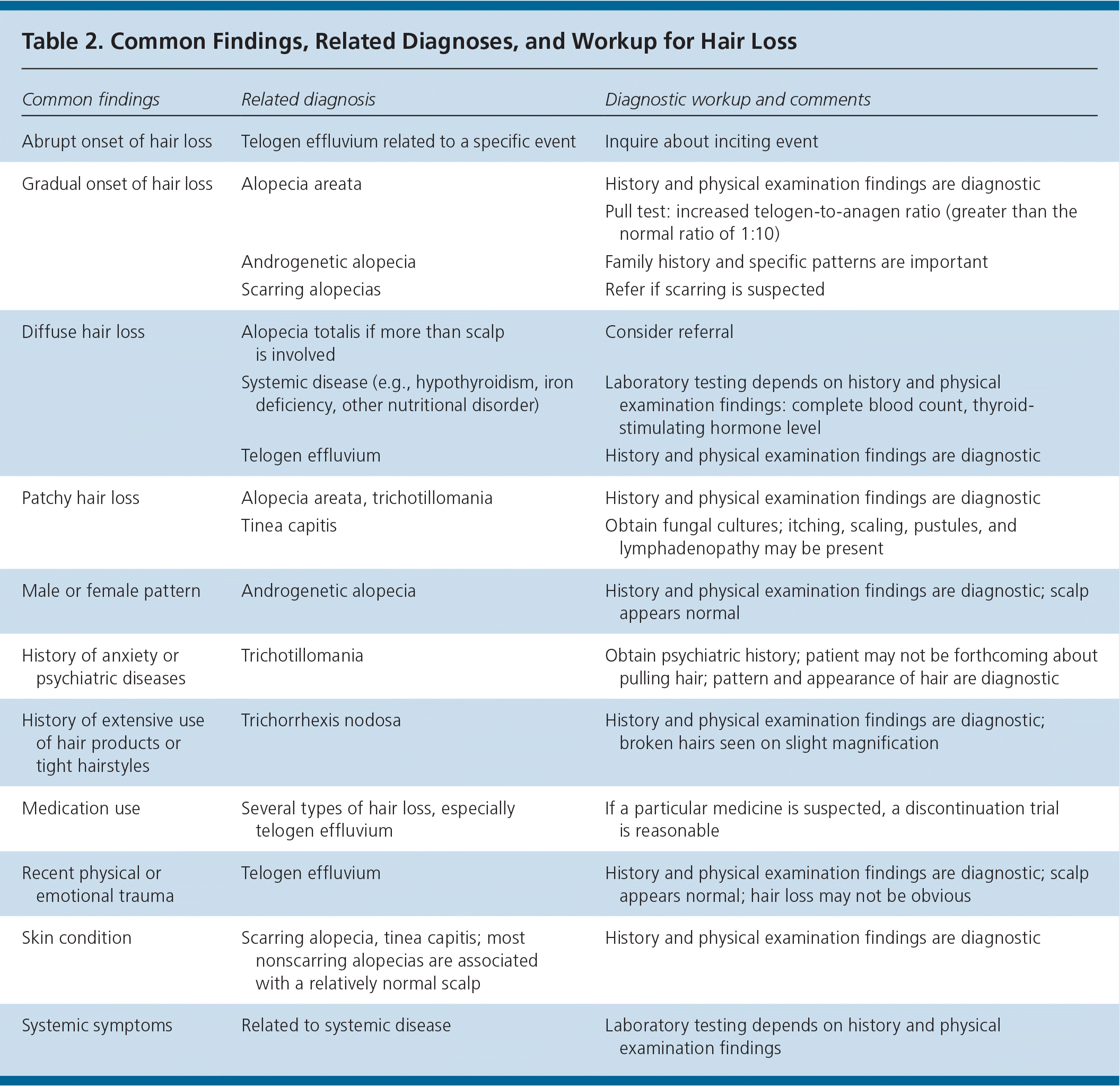
If your doctor thinks a hormone problem, vitamin deficiency, or infection caused your hair loss, a blood test can help confirm the cause. A trichogram, or “pluck test”, entails the actual plucking of 40–60 adjacent hairs from a defined area and the examination of their intradermal portions under the microscope. A reduced anagen vs telogen ratio, demonstrating the presence of greater than 25% telogen hairs, establishes telogen effluvium. For example, alopecia areata is an autoimmune condition that results in total hair loss. Thyroid conditions and fluctuations in thyroid hormones may also cause hair loss. Allergic contact dermatitis to hair dyes can also result in hair loss.
Hair loss symptoms
If you have any concerns with your skin or its treatment, see a dermatologist for advice. DermNet does not provide an online consultation service.If you have any concerns with your skin or its treatment, see a dermatologist for advice. Telogen effluvium has been related to a variety of insults which can be physical, mental, or chemical in nature [1,4]. By clicking submit you agree to our Privacy notice and Terms and conditions.
Telogen effluvium symptoms
The human infection COVID-19 is brought on by this strain of the Coronaviridae family. The clinical manifestation of COVID-19 ranges from asymptomatic infection to a multiorgan illness that is potentially fatal. Due to the virus’ affinity for angiotensin-converting enzyme 2 receptors, pulmonary epithelial cells and pneumocytes are the primary target organs of SARS-CoV-2 [13]. The COVID-19 global pandemic has had a significant psychological impact on the populace. Dermatological problems are another, less well-known, set of complications that this complex disease exposes its victims to [9].
After Hair Loss, I Learned to Love Myself Again
Why You're Losing More Hair and the New Science to Help Regrow It - Oprah Mag
Why You're Losing More Hair and the New Science to Help Regrow It.
Posted: Mon, 11 Sep 2023 07:00:00 GMT [source]
“During menopause, hormonal changes, specifically a decrease in oestrogen levels, can affect hair growth cycles. This often leads to thinning of the hair, particularly at the crown and along the parting line. “The condition is thought to be hereditary and while it doesn't usually cause baldness like in men, it can still affect self-esteem and confidence.
With this in mind, one expert spoke with Express.co.uk about some of the causes of thinning hair. A graphic illustration of the correlation between inflammation related Covid-19 and Telogen effluvium has been reported in Figure 2. Our experts continually monitor the health and wellness space, and we update our articles when new information becomes available. Hair transplant surgery involves moving small plugs of skin, each with a few hairs, to bald parts of your scalp. If they suspect an autoimmune or skin condition, they might take a biopsy of the skin on your scalp.
Most scalp hairs last about three years and grow about 1 cm a month. After a period of time (about three years), each hair on the scalp comes to the end of its life and falls out. Telogen effluvium (hair loss) is a condition where more than normal amounts of hair fall out. Unlike some other hair and scalp conditions, it is temporary and the hair growth usually recovers. Telogen effluvium happens when a considerable number of hair follicles, around 25%, enter the telogen (resting) phase of the hair growth cycle prematurely and shed their hair. Monari et al. [26], in a cross-sectional study which enrolled 96 patients with a diagnosis of SARS-CoV-2 pneumonia, identified TE in 31.3% of patients, with a significant difference in sex (females 73%, males 26.7%).
Yes, hair loss from telogen effluvium is typically reversible, and the hair often grows back once the underlying cause or trigger has been addressed. A significant number of studies have indicated that the dysregulation of lncRNAs is strongly correlated with the onset and development of AGA [68,69]. HFSC aging characterized by the loss of stemness and by epidermal commitment leads to the progressive miniaturization of hair follicles, representing the critical mechanism of AGA [70].
TE is typically a physically or psychologically stressful event [1,2,3,4] and is the most common diffuse type of hair shedding because of the premature termination of anagen and hair follicle entry into catagen. As reported, SARS-CoV-2 triggers a strong cytokine storm, increasing the levels of IL-1β, IL-6, IL-2, IL-17, IFN-γ, MCP-1, IP-10. In fact, the inflammatory cytokines, including IL-6, TNFα, IL-1β, and IFN-γ, develop the catagen cycle in experimental studies has been demonstrated [35]. Furthermore, anticoagulant proteins are decreased due to the anticoagulation cascade in response to COVID-19, leading to microthrombi formation and obstructing hair follicle blood supply.

If you have telogen effluvium, you may lose up to 300 strands of hair per day. TGF-β1 and Wnt signaling pathways are the most crucial pathways that maintain a quiescent niche and regulate the proliferation and differentiation of HFSC [75,76]. Moreover, Leirós et al. [81] found that Wnt pathway inhibitors (DKK-1) impair the differentiation of HFSC, and the addition of promoters (Wnt10b) can reverse this effect in AGA. “Traction alopecia is a type of hair loss caused by prolonged pulling or tension on the hair follicles. This often happens when hairstyles like tight ponytails, braids, or extensions are worn regularly.
Telogen effluvium is a form of hair loss that involves hair thinning or increased hair shedding. It occurs more often in women and is usually due to a disturbance in the hair cycle. Typically, the patient is a lady who reports having had a “full head of hair” but noted that it “began suddenly” to “come out by the handful”. Usually, and differently from AGA, the patient is accurate in giving the date of onset of her hair loss.

Telogen effluvium is caused by an abnormality in the normal hair cycle, which is triggered by numerous factors. Reach out to your healthcare provider as soon as you notice hair loss, especially if it causes additional stress. “Ingredients like sulphates, parabens, and formaldehyde can irritate the scalp and weaken the hair, making it more prone to falling out. “It’s best to avoid repetitive wear of hairstyles that pull too tightly and give the hair regular breaks from tension, especially if you notice your hair thinning. In fact, around 40 percent of women aged 70 or over experience the condition in some form. Dihydrotestosterone, obtained by the conversion of testosterone through the 5-alpha-reductase function, promotes the activation of androgen receptors (ARs), causing hair loss.
This involves carefully removing several small sections of skin for laboratory testing. This usually happens because of radiation treatment or chemotherapy. The main symptom of alopecia is losing more hair than usual, but this can be harder to identify than you might think. You'll soon start receiving the latest Mayo Clinic health information you requested in your inbox.
“While not all women experience hair loss during menopause, those who do may find it distressing. The most recent observational cross-sectional study included 198 patients and was published in May 2022 by Seyfi S. Et al. [25], and confirmed that TE is one of the consequences of the COVID-19 pandemic. The authors affirmed that COVID-19triggers TE via the necessary medications’ treatment and stress situations. Interestingly, Shome et al. [23] reported that 20 adult patients (all women) showed TE episodes a few weeks after recovery from COVID-19 infection, continuing for more than six months. It’s best to see a healthcare professional for any unexplained hair loss so they can determine the underlying cause and best course of treatment.
Telogen effluvium is a temporary and often reversible form of hair loss. This type of hair loss occurs after stressful events, such as illness or childbirth. Traction alopecia is a type of hair loss caused by prolonged pulling or tension on the hair follicles. According to Dr Shah, female pattern hair loss, also known as androgenetic alopecia, is common and can occur at any age.
Often the first sign of regrowth will be the appearance of short little hairs at the front hair line, Freeman said. With TE, your scalp sheds a higher-than-normal amount of hair, usually around the top of your head. Because your hair looks thinner, you may worry you’re going bald, but it will grow back in time.


No comments:
Post a Comment